
If you train after a physical shift, a two-minute rest can feel like time you should be spending lifting. Cut every break to thirty seconds, though, and your next set may be limited by how little you have recovered. The session ends sooner, but you may also finish with fewer useful repetitions.
For muscle-building training, give yourself enough rest to attempt the next set with the planned load and a consistent movement. As a practical starting point, try around two to three minutes after demanding compound exercises and one to two minutes after smaller isolation exercises. These are adjustable starting points, not fixed rules that suit everyone.
What the research actually tells us
In an eight-week study, 21 resistance-trained young men used either one-minute or three-minute rests. The three-minute group gained more squat and bench-press strength and more muscle thickness at the front of the thigh. Results did not show a clear advantage at every muscle measured. This supports allowing proper recovery, but it cannot establish the best rest period for every lifter or exercise. Schoenfeld and colleagues, 2016.
A separate ten-week lower-body trial involving 28 people compared one-minute and three-minute rests, including conditions that matched the total weight lifted across sets and repetitions. The higher-work conditions produced greater quadriceps growth, including when that work was completed with short rests. The result suggests that some benefit of resting longer comes from preserving the work you can do, rather than the clock itself. It does not make total tonnage a universal measure of muscle growth. Longo and colleagues, 2022.
However, these were small studies, not trials of tradespeople training after long shifts. They give useful direction without providing a personalised prescription for your work schedule.
Match the break to the exercise
A hard squat set and a set of cable curls do not have to use the same timer. Consider how demanding the set was, which muscles worked and what you need to do next. A heavy set, an exercise involving several joints or a set taken very close to your limit may call for more recovery.
Use your program's prescribed rest where it has one. If it does not, the starting ranges above give you something to test. Take longer when needed. There is no prize for beginning the next set while you are still unable to set up properly or control the movement.
Equally, you do not need five minutes after every easy warm-up set. Keep warm-ups and demanding work sets separate in your thinking. The purpose of the break is to prepare for the next task.
Use the next set as feedback
Start your timer when the set finishes. Then record the load, repetitions and approximate rest alongside your usual notes. This makes it easier to distinguish a strength change from a change in how you ran the session.
Suppose your first set reaches the top of your planned rep range, but the next set falls well below it. That drop does not automatically mean the program is wrong. If you rushed the break, try allowing more time before cutting the load or adding another set to make up the difference.
Some reduction in repetitions across hard sets is normal. You are looking for a pattern, not demanding identical numbers every time. If a longer break helps you stay closer to your target with the same movement, it is doing a useful job. If it does not, review the load, effort and exercise setup instead of extending rest indefinitely.
Keep the session short without rushing every set
Rest has a clear time cost. Across three work sets, changing both between-set breaks from one minute to three minutes adds four minutes.
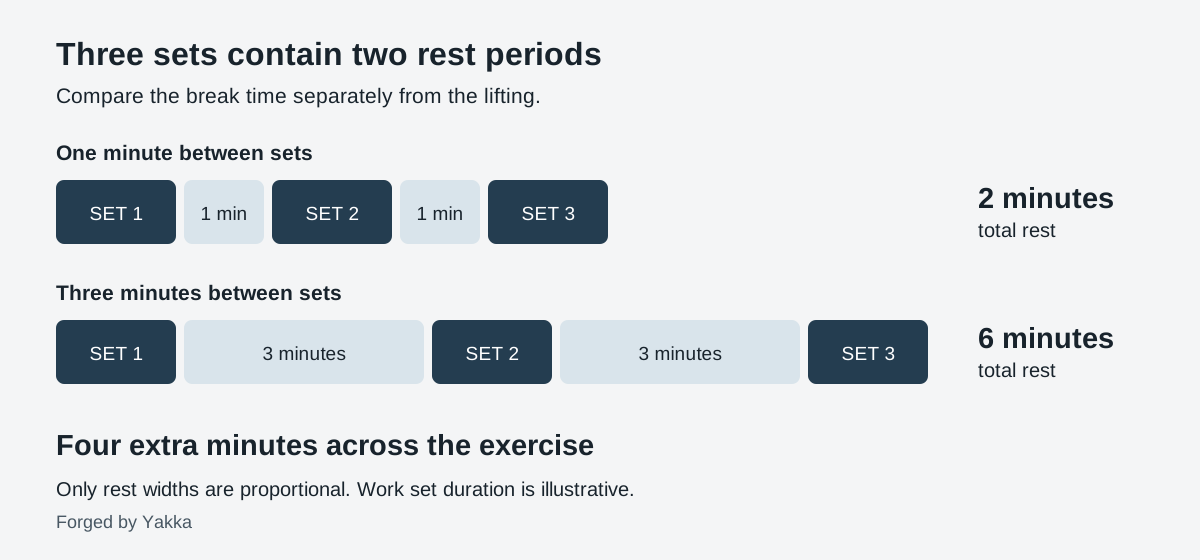
Decide where those minutes matter most. Protect recovery before demanding sets, keep equipment changes straightforward and avoid turning a rest break into a doomscrolling session. Put the timer somewhere you can see it without opening another app.
If your program regularly overruns the time you have, review its exercise and set count rather than automatically compressing every rest period. For the broader question of fitting useful training into a smaller week, see minimalist training for muscle growth.
A simple test for your next workout
Choose one exercise where later sets regularly fall apart. Keep the exercise, load, setup and intended effort as similar as practical, and record the rest you actually take. At a later comparable session, allow a longer break and compare the repetitions and movement quality.
Treat that comparison as a way to improve your session. Workload, sleep and ordinary day-to-day variation can affect what you lift. Use a few sessions to judge the pattern rather than reacting to one poor set.
When time is tight, the useful question is whether a shorter break helps you complete the planned session without undermining the sets that matter. Keep the timer as a tool. Let the quality of the next set help you decide whether the break was long enough.
References
- Schoenfeld BJ and colleagues. 2016. Longer Interset Rest Periods Enhance Muscle Strength and Hypertrophy in Resistance-Trained Men. Journal of Strength and Conditioning Research, 30(7), 1805–1812. DOI 10.1519/JSC.0000000000001272. Study record.
- Longo AR and colleagues. 2022. Volume Load Rather Than Resting Interval Influences Muscle Hypertrophy During High-Intensity Resistance Training. Journal of Strength and Conditioning Research, 36(6), 1554–1559. DOI 10.1519/JSC.0000000000003668. Study record.