
Our advice at Forged By Yakka is simple: choose a weight you can control, lower it deliberately and use the full comfortable movement for the exercise. Keep doing that as you get stronger. Do not cut your reps short just to put more weight on the bar.
When you have worked all day and made time for the gym, you want that effort to count. Start by doing each exercise properly enough that you can recognise real progress next week.
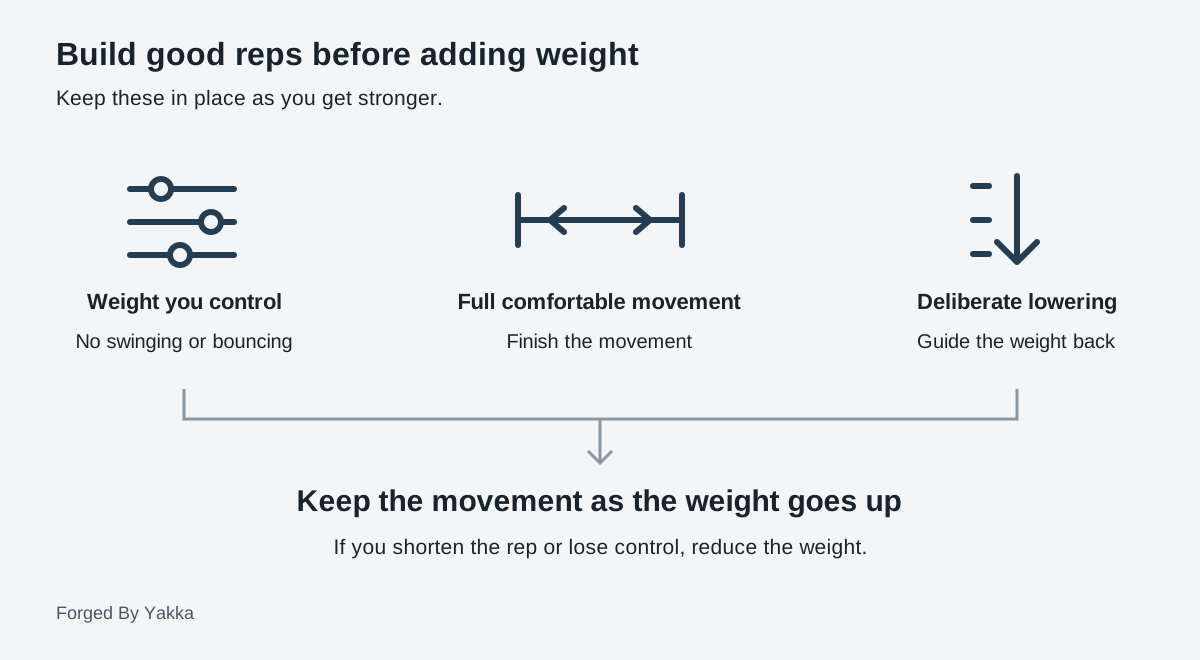
Choose a weight you can control
Use a weight that lets you complete the movement without swinging, bouncing or changing your position just to finish the rep. You should still have to work. The last few reps can feel hard without turning into a different exercise.
Take a chest-supported row. Keep your chest against the pad and pull through the same movement each time. If adding weight means lifting your chest away and barely moving your arms, reduce the weight and get the movement back.
The weight on the machine matters, but so does what you actually do with it.
Lower the weight deliberately
The return is part of the rep. Guide the weight back instead of letting it drop or slam into the stops. On a curl, that means lowering the dumbbell with control rather than simply letting your arm fall.
You do not need to count an exact number of seconds unless your program calls for it. Research comparing different lowering speeds has found mixed results, rather than one pace that builds the most muscle everywhere. That does not make the lowering phase unimportant. Our practical advice is to control it and keep it reasonably consistent. Kojić and colleagues, 2021; Azevedo and colleagues, 2022.
Use the full comfortable movement
For everyday muscle-building training, our starting point is the full range you can comfortably control for that exercise. That means completing the movement rather than quietly making it shorter as the weight gets heavier.
For example, if your curls usually travel from a comfortably straight arm to the top of the curl, do not start stopping halfway down just because you picked up a heavier dumbbell. Keep the movement and choose a weight that lets you finish it.
Full range does not mean forcing your joints into a painful position or bouncing into a deeper stretch. The right setup depends on the exercise, the equipment and your body. If you are unsure where a movement should start and finish, ask a qualified coach to check it. Stop an exercise that causes sharp or worsening pain and get qualified guidance.
Deliberately planned partial reps can have a place in a program. Research has found useful results in specific exercises with selected parts of a movement where the muscle is more stretched. Those ranges were chosen in advance. That is different from shortening a rep because the weight is too heavy. Planned partials are not the default advice in this article. McMahon and colleagues, 2026.
Earn the extra weight
Keep a simple record of your weight and reps. A note about a machine's seat setting or your grip can help you repeat the same setup next time.
If your program asks for 8 to 12 reps, work towards the upper end while keeping the full movement and controlled lowering. Follow the program's progression rules when you increase the weight. If the extra weight makes you cut the movement short or lose control of the return, it is too much for the version you are trying to train.
You can also make progress by doing another good rep with the same weight. There is no need to force a heavier number every session.
At your next workout, pick one exercise and check the basics: a weight you can control, a deliberate return and the full comfortable movement. Keep those in place as the reps and weight improve. Make your time count by making your reps count.
References
- Kojić F and colleagues. 2021. Effects of resistance training on hypertrophy, strength and tensiomyography parameters of elbow flexors: role of eccentric phase duration. Biology of Sport, 38(4), 587–594. DOI 10.5114/biolsport.2021.99323. Study record.
- Azevedo PHSM and colleagues. 2022. Effect of different eccentric tempos on hypertrophy and strength of the lower limbs. Biology of Sport, 39(2), 443–449. DOI 10.5114/biolsport.2022.105335. Study record.
- McMahon G and colleagues. 2026. Moderate Intensity Resistance Training With Partial Range-of-Motion at Long Muscle Lengths Elicits Similar Hypertrophy and Architectural Adaptations as High Intensity Resistance Training Using Full Range-of-Motion. Journal of Strength and Conditioning Research, online ahead of print 2 July. DOI 10.1519/JSC.0000000000005561. Study record.